
An Experiment in the (Re)Distribution of Grades: A Pedagogical History
Way back when, in the halcyon days of my previous RMWMTMBM blog, I posted about this little experiment that I planned to implement in my courses, which I imagined at the time might serve three purposes:
(1) it would get students engaged and talking to one another in the first week,
(2) it would force students to be engaged and talking to one another using principled arguments about something of importance to all of them, and
(3) whatever principled disagreements they had with one another in that first initial conversation would had to be worked out in real time, with real consequences… democratically.
As much as I’ve tried, I can’t precisely pin down when I first implemented what I then called “An Experiment in the (Re)distribution of Grades” (hereafter, “ERG”) in my classes, but my best guess is that it was sometime around 2015-2016. What I can say without absolute certainty, however, is that since I started implementing ERG in my classes on the first or second day of every intro-level course (however many years ago), I have not stopped doing it since.
Fortunately, I was able to semi-preserve my original account of it, which I reproduce (unedited) below:

WARNING: If you still believe that academia is a meritocracy, that higher ed assessment instruments are useful (or unbiased), that grades motivate students to learn, or that grades accurately reflect students’ performance, this essay is not for you.
Now, let’s talk about grades.
No matter how fastidious one is about one’s course design, every prof knows that there is more than a little bit of alchemy involved in assigning final grades to students. Even the so-called “hard” sciences cannot escape the endemic problems of “subjective grading” (which students find unfair) and “grade inflation” (which professors find unsound). Exam answers may be objectively “right” or “wrong,” but which questions are asked, how they are weighted, even the material conditions of the room in which students take an exam, are all variables that are the result of some set of subjective decisions.
Grade inflation, on the other hand, is whole ‘nother can of worms. Adjuncts, non-TT professors, female professors, faculty of color, or any other of the increasingly-common variants of precariously-employed faculty are under heightened pressure to inflate student grades in the interest of their professional survival. (Show me a professor whose average student grade is a C and I’ll show you a white, male, tenured professor!) But it’s not only the academic precariat contributing to the endemic of grade-inflation; in fact, the most commonly awarded grade to Harvard undergraduates is an A, and the median grade at Harvard University is an A-.
Perhaps it is the case that every Harvard undergraduate is “excellent” – that would be the explanation of the meritocracy evangelists – but that would be a seriously deficient understanding of “excellence,” which (according to Spinoza) really ought to be as difficult as it is rare.
Students know this, too. They know that, by and large, their grades are neither purely objective nor entirely accurate assessments of their learning or performance. When they work hard and do well, they are quick to tell you so… often in reference to the truly average hoi polloi who also passed your class, of course.
I have long been of the opinion that grades are neither meaningful nor motivational. More often than not, in my view, grades impede student learning. In fact, I would argue that students’ myopic concentration on grades gets in the way of not only their development of concrete skill-sets (reading, writing, comprehension, computation, critical thinking, analysis, etc.) but also their ability to cultivate a “love” of learning, to develop a sense of self-motivated curiosity, and to productively bridge the gap between inside-the-classroom and outside-the-classroom. I do not think this is students’ fault.
They are trained in primary and secondary schools to be test-takers, not learners, and they have been fed a steady diet of lies for 18 years before arrive in our classrooms about academia’s (and America’s) illusory meritocracy. Not their fault.
Nevertheless, I have to assign grades. And so, over the years, I have tinkered with assessment tool after assessment tool in a Sisyphean attempt to inoculate my courses against bias and grade inflation. For my first 5 years of teaching, I only assigned papers/essays in my courses, and (like most humanities profs) I was eventually forced to design and distribute a rubric for how I graded them. I’ve always made “participation” count for at least 10% of students’ grades, but I eventually had to spell out specifically on my syllabi what I meant by “participation” (which students tend to wrongly conflate with “attendance”) and how that element was to be graded. I eventually began to incorporate “objective” quizzes with things like definitions, multiple choice questions, and true/false questions.
As it turned out: there was very little change (< 7%) in the grade-distribution for my courses, despite all this assessment busy-work on my part.
More importantly, also unchanged was:
(1) students’ attitudes toward their grades, as they still prioritized scoring well over actually learning,
(2) students’ expectations with regard to their grades, as they still tended to think that merely “doing the work,” and not doing it “excellently,” deserved an “A,” and
(3) students’ understanding of how grades are earned, not “given” (in spite of all the explanatory rubrics at their disposal).
The ONE AND ONLY change in course-design that has effected a significant difference is one that I made two years ago, when I borrowed an idea from my friend and former mentor, Theron Britt (English, University of Memphis), and began grading all of my courses on a “1,000 Point Scale.”
(I won’t bother to explain the 1,000 Point Scale because, well, it’s mostly self-explanatory.)
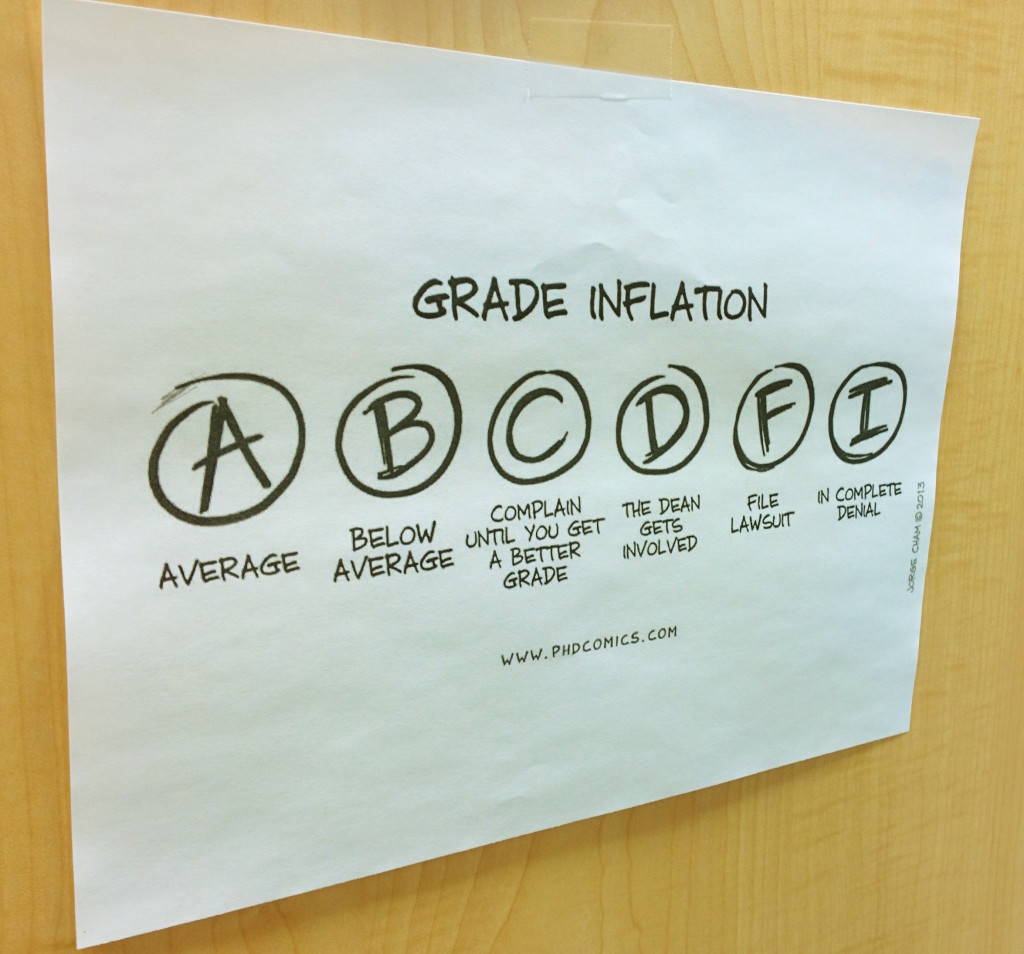
This shouldn’t come as a surprise to anyone familiar with the ubiquity of (what Cathy O’Neil calls) “weapons of math destruction,” but students are far less inclined to dispute grades that come to them in the form of a point-scale than they are to dispute the more traditional assignments of letter-grades, which require the prof and students to share an understanding of ambiguous value categories like “Average,” “Below Average,” and “Above Average.” In the very first semester after I implemented Britt’s 1,000 Point Scale, it more or less eliminated the complaints I received about grades, as well as the petitions to “bump up” a C+ to a B, or a B+ to an A, or (and this is always the one that smarts) an A- to an A.
Almost immediately, incorporating Britt’s 1,000 Point Scale felt as if someone had waved a magical wand over my courses and somehow effected a semi-synchrony-of-understanding between my students and myself with regard to the whole charade of grading. As a prof, it has made my end-of-semester life exponentially easier, happier. and better. I really cannot recommend it enough.
Then, at the end of this past semester, one of my students asked me a question (I think in jest) that made me completely rethink the whole charade of grading again. The student had ended the semester with a total of 965 points. Since my institution doesn’t assign “plus” or “minus” final grades, she had earned an “A” in my course… and (as she explained to me) “65 pointless points.” So, she wanted to know if she could give her extra points to her friend, who had ended the semester with 875 point.
I said no, of course, because I had not stipulated this possibility in my syllabus at the beginning of the semester, but the idea of redistributing these “pointless points” at the end of the semester got me thinking.
It is, perhaps, a truly revolutionary idea.

So, this semester, I plan to try out what I’m calling an “Experiment in the (Re)distribution of Grades.” I haven’t worked out all of the details of how this experiment will work– and I am inviting readers to please offer recommendations in the comment section below— but what follows is my rough idea.
I will keep my syllabi and my 1,000 Point Scale as they are now. On the fist day of class, when I explain the syllabus and course requirements, I will point out to students that this means that some students will end the semester just short of the number of “points” they need to achieve the next-higher letter grade, and other students will end the semester with what are, effectively, “pointless points.” I will inform students that there won’t be any “bumping up” of points, no matter how close they are to the next-higher letter grade, and there won’t be any “extra credit” points offered at the end of the term.
On the first (or second) day of the course, students will engage in a symposium, guided by two questions:
(1) Assuming that many (if not most) of us will end the semester with accumulated “pointless points,” do we (as a class) want to (a) determine a fair and just way to collect those “pointless points” into an “invisible pool” and (b) determine a fair and just way to redistribute them at the end of the term?, and
(b) If we do adopt such a plan, what will be our fair and just rules for collecting and redistributing points?
And now, the experiment begins. Depending on what day of the week the class meets, each class will have only 50 or 75 minutes to accomplish the following:
STEP ONE: The Decision
I will give students the option, first, to decide whether or not they want to adopt a redistribution plan at all. Students themselves will be responsible for determining the process (unanimity?, majority? supermajority?, consensus?) by which their decisions will be adopted or rejected. Whether or not they they decide to avail themselves of this ERG option at all (which I suspect not all classes will), there is a caveat, namely, that they must first engage in meaningful collective deliberation.
STEP TWO: The Deliberation
IFF the class decides to adopt an ERG plan, then before the class concludes on that same day, students must work together to formulate “just” and “fair” principles for how the extra points will be (a) collected and (b) redistributed. Some questions they will have to consider include:
- How will you determine which points are sufficiently “extra” to warrant their being contributed to the pool? Will ALL “extra” points go into the pool, leaving each student in the class with the lowest possible point-score– e.g., 900, 800, 700, etc.– for the final grade s/he receives? (In this scenario, both a person with 995 points and a person with 695 points would be required to “give up” 95 points to the pool.) Will only points above the halfway mark of a grade warrant being contributed to the pool? (In this scenario, a person with 885 points would contribute 0 points, but a person with 845 points would contribute 45 points.) Or, alternatively, will students with grades less than x number of points short of the next grade contribute points? Will students with, say, a C or higher contribute points, while students with lower than a C contribute nothing? Or vice versa? (NOTE: In practice, I do not lay out all of these alternative scenarios for the students. They have to figure it out for themselves. I’m only noting them here for illustration.)
- How will you determine the principles for the redistribution of the pool points? Do pool-points go first to those who have the lowest grades? Or to the students whose grades are closest to the borderlines between grades? Or to those students who will fail the course without extra points?
- How do you explain the justness of your redistribution principles? Can they be universally applied? Are they “unbiased”? Do they prioritize the good of the whole (class), or the good of each individual (student)? Do they attend to need, or do they reward merit? Are they “fair”? How so?
My suspicion is that many, if not most, students will not be in favor of adopting redistribution principles in the first week of class, in large part because – bless their hearts – students tend to have the very best (even if frequently insincere) intentions and very optimistic (even if frequently unrealistic) expectations with regard to their performance in a course at the beginning of a term.
It is also my suspicion that the Meritocracy Force is strong with these ones, and the very idea of giving up their hard-earned points to one of their classmates, about whom they know little and for whom they care less at the beginning of the term, will be anathema.

For these reasons, I have last trick up my sleeve in this experiment…
I won’t tell students this at the start of the term, but there is on more step in this process, chich will come in the LAST week of the course, after students more or less have an idea of their performance in the class and after they have spent 16 weeks with their classmates. I’m calling this final step…
STEP THREE: The Reconsideration
Let’s give ’em another chance! In the last week, students will be given a one-class-period long opportunity to reconsider Steps One and Two. That means they’ll two questions before them:
(1) Do we want to keep or abandon the ERG plan?, and
(2) If we keep the ERG plan, do we want to revise the principles we adopted for the collection and redistribution “pointless points”?
(*Note: For classes that opted NOT to adopt an ERG plan at the start of the semester, this is still an option.)
I think this is an important step to include for all of the reasons I mentioned at the end of Step Two. Students will have a better sense of how difficult (or easy) the course was and how they performed, but they will also know (and hopefully care) about their classmates more at that point.
Just like governmental aid programs, which are easy to dismiss as “entitlements” when you (or the people you know) have what you need and easy to justify as “entitlements” when you (or the people you know) do not, this experiment is meant to get students’ thinking more critically about the meaning, use, and value of ideas like “earnings,” “merit,” and, yes, “grades.”
Students will (hopefully!) have significantly better philosophical chops at the end of the semester, which should aid in their deliberations. They will have been exposed to an array of philosophical approaches to determining the “just,” the “right,” and the “good,” as well as a number of critiques of (what might have been) their default criteria for determining those.
Where they had been asked to enact an exercise in “ideal theory” in the first week of classes, more or less behind a veil of ignorance, they will now understand not only their own vested interests in the outcome of their deliberations, but also the interests of their classmates.
They will, in effect, get to participate in real democratic deliberation, unencumbered by familial, religious, or corporate interests, party politics, technological manipulation, or executive/professorial interference.
They will, in a situation that has an actual import for their lives and the lives of those with whom they share a world, be charged with the collective determination of “the good” of the people, by the people, and for the people.
UPDATE: you can read more about my implementation of this experiment in Part 2 and Part 3.